Are the Lord of the Rings Movies Actually Good Adaptations of the Books?
A sentiment analysis of both the novels and movies from Middle-Earth
Project details
Project Requirements
- Explore the texts of the novels and movie scripts.
- Perform sentiment analysis on both.
- Visualize the results and compare the two mediums.
Project Overview
The Lord of the Rings trilogy films, based on the novels by J.R.R. Tolkien, are among the most acclaimed franchises in the world and collectively won 11 Oscars. They are also widely regarded as one of the best book-to-film adaptations. The novels themselves rank among the best-selling books of all time—at one point second only to the Bible.
Of course, differences exist: some characters or scenes were cut, and certain lines were reassigned to different characters. A word-for-word adaptation is impossible, but as Peter Jackson (director and co-writer) once explained:
The themes of Tolkien are another way of honouring the book. Because there’s so much detail that you ultimately can’t recreate. You can’t recreate the world of The Lord of the Rings with everything in the books. But, the thematic material is obviously critically important to translate from book to film. Because the themes are ultimately at the heart of any book.
I wanted to find out how well the movies translated Tolkien’s themes. I should admit some bias: I love both the books and the movies. I rewatch the films every year, can quote them in my sleep, and I’ve reread the novels multiple times. This research would either confirm my love for both—or crush me entirely.
The Data
I analyzed the texts of both the novels and the extended-edition scripts. Each was stored as a .txt file. Every word was compared against a sentiment lexicon—a list of words with associated emotional connotations. I used the NRC lexicon, which not only classifies words as positive or negative, but also associates them with emotions such as anger, fear, anticipation, trust, surprise, sadness, joy, and disgust. By applying sentiment analysis to both the books and the scripts, I could compare them on an emotional level. I analyzed the full scripts, not just the dialogue, since they also include scene descriptions and the emotions the filmmakers intended to convey.
The analyses were performed in R, which has powerful tools for text processing. Using the tidyverse package, I cleaned the text by removing punctuation, numbers, and extra spaces. Unfortunately, I also had to remove the word Merry—the name of a hobbit, but also an emotionally charged word in the lexicon. As a preliminary step, I created word clouds of the 100 most frequent words from both mediums:
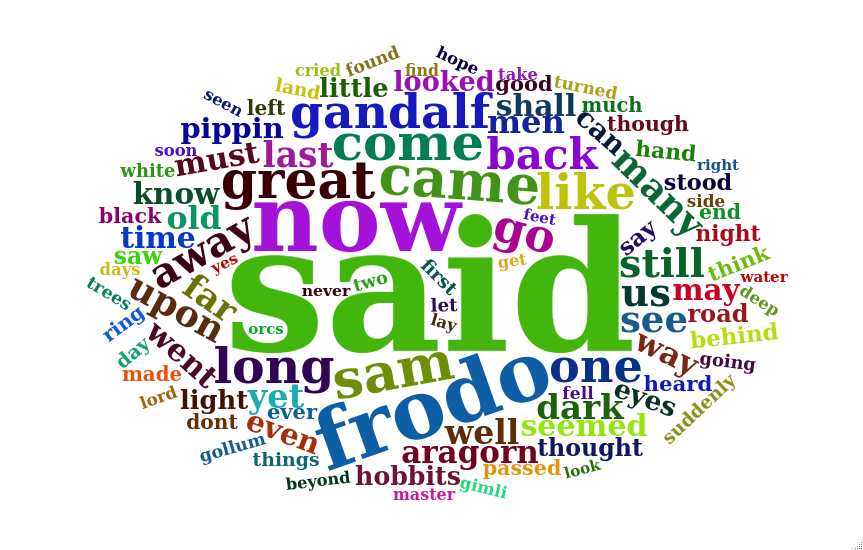
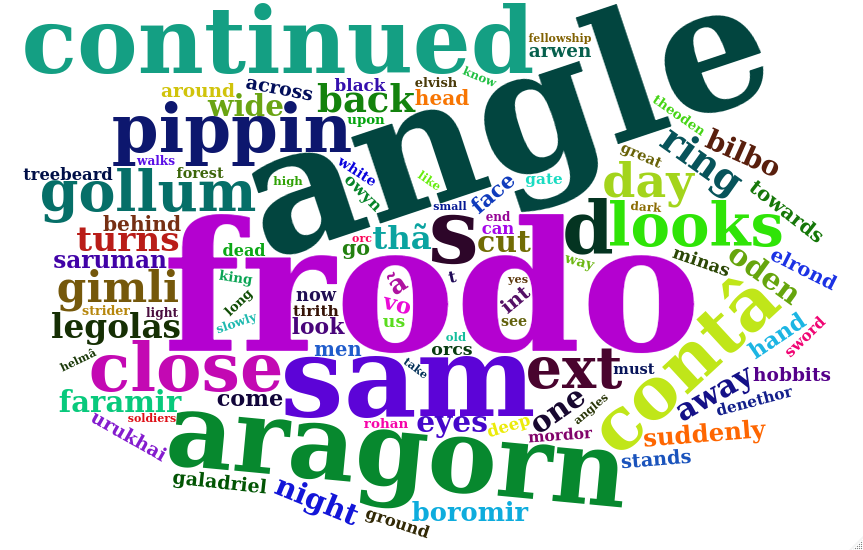
The scripts, as expected, were more technical in nature, with terms specific to filmmaking. The books, meanwhile, contained richer descriptive language. The novels also had a more even distribution of word frequencies, while the scripts featured a few dominant terms. These differences were expected, but it made the sentiment comparison all the more interesting.
Sentiment analysis and comparison
After cleaning the texts, I wrote three R scripts: two to extract the sentiment scores from each trilogy and a third to compare the results. I normalized the data so both sets would be on the same scale. The bar charts below show how often words associated with each emotion appear in the texts. To make comparison easier, the bars are sorted by the books’ sentiment scores. (Click to expand.)
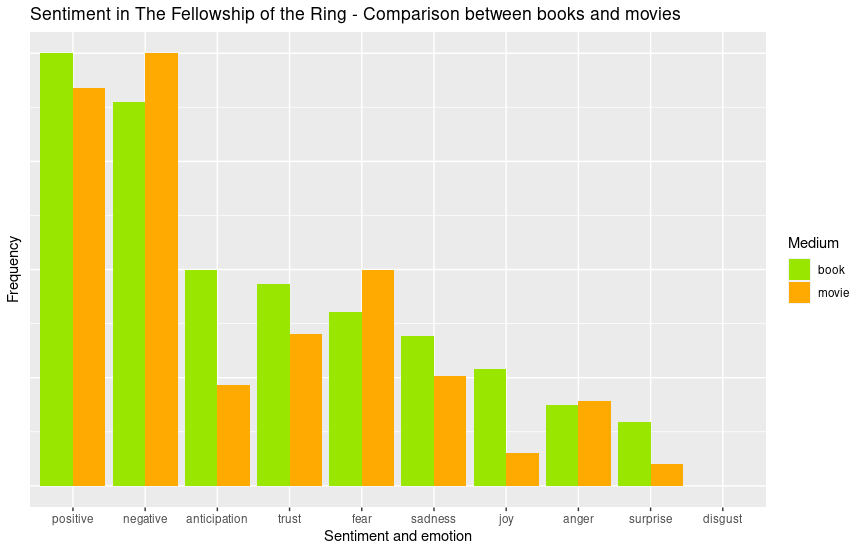
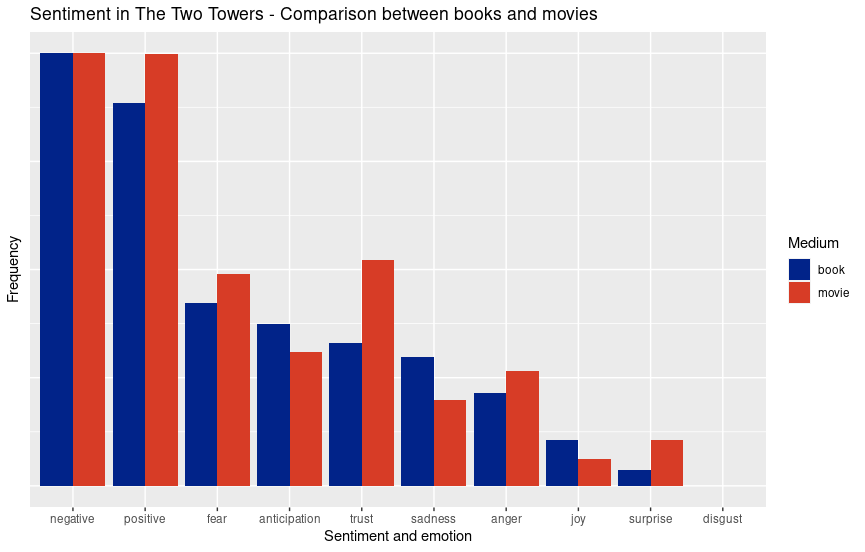
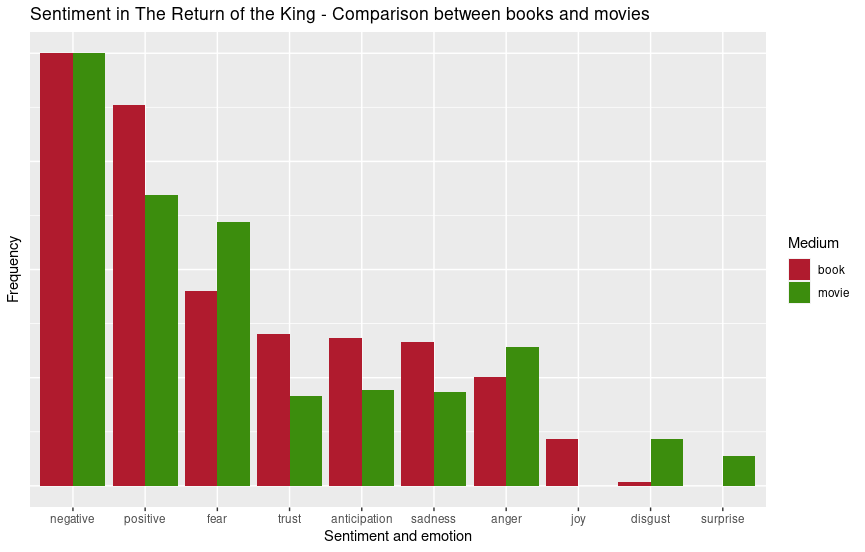
The results show that the scores are similar across most emotions. While there are differences, none are extreme. Tolkien’s linguistic mastery is difficult to match, but in terms of positivity and negativity, the movies and books are nearly identical. The top four emotions across both mediums were trust, fear, anticipation, and sadness.
Which book was best adapted?
- The Fellowship of the Ring matched in 7 of 10 sentiment categories.
- The Return of the King also matched in 7 of 10.
- The Two Towers matched in 8 of 10, making it the most faithful adaptation in terms of thematic tone—even if it contains one of the most controversial additions for book purists (elves at Helm’s Deep?!).
At this point, it’s safe to say that the movies did a remarkable job adapting the books! Both mediums carry a very similar emotional weight. And honestly, no one just sits down to watch a single Lord of the Rings film—you binge the whole trilogy. Tolkien himself always intended the story to be published as one single book, after all. With that in mind, here’s a chart comparing the sentiments across the entire trilogy.
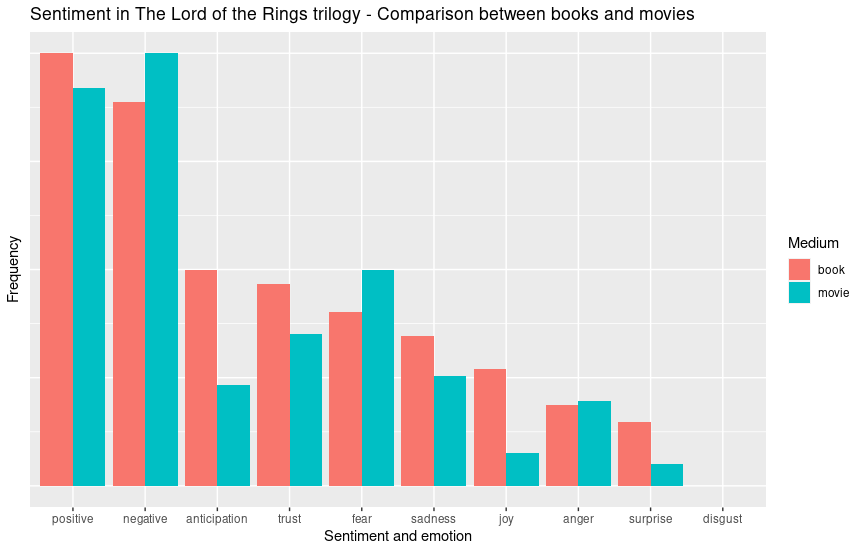
Yet again, 7 out of 10 sentiments have a similar score. This shows that the movies did indeed do justice to the novels. My appreciation for them is no longer just subjective enthusiasm—it’s supported by data.
It's time that I reread the books and plan a movie marathon once more.